Categories: 
Written by: 
Mînzat Valeria

Easter Traditions in Romania

Easter is probably the biggest Christian holiday. Most Romanians celebrate the Orthodox Easter and, while from a religious point of view it signifies the resurrection of the Lord Jesus from the dead, there are also many traditions and customs surrounding this holiday. If you want to celebrate Easter in Romanian style, you should definitely know about these ones!

Getting ready for Easter in Romania

Getting ready for this special holiday is a whole ritual in Romania. It all starts on Joia Mare, or Big Thursday, which is the Thursday before Easter, that is always on a Sunday day. On Joia Mare everyone should work around the house: cleaning, dyeing the eggs, baking Pasca (traditional cake made from leavened dough filled with cottage cheese) and preparing the lamb meat. Then, on Vinerea Mare, or Big Friday, one should not eat, drink or work. Saturday is also a day to prepare for the holiday, and the night from Saturday to Sunday every family would go together to church to bless the food they prepared for Easter, but also to receive the Holy Fire, which they’ll take in their house through a lightened candle, as to let it burn and bring peace for the year.

Dyeing the eggs

There are different traditions on dyeing the eggs and all of them are related to a legend that says that Mary went to Jesus when he was crucified on the cross and, in her great pain, she began to weep and placed a basket of eggs at Jesus' feet. Blood spilled onto the eggs, so they turned red. Every Romanian house has their own method of dyeing the eggs, and also decorating them. In the regions of Moldova and Bucovina for instance, the technique is very complex and eggs are decorated with very detailed traditional motifs. They are so special that there are even museums of painted eggs.

Egg knocking

Everyone looks forward to the custom of knocking and cracking the eggs. The meaning behind this is that when we crack the egg and thus break its shell, we are actually celebrating the moment when Jesus Christ rose from the dead. Also, while doing so, but also the first thing in the morning, we say to each other: Hristos a Înviat, and respond: Cu Adevărat a Înviat, which means that we are acknowledging the resurrection of Jesus. This type of salute lasts for 40 days, until another important religious holiday, the Ascension Day, and then for another 10 days we greet each other with the phrases: Hristos s-a Înălțat and Cu Adevărat s-a Înălțat, acknowledging the bodily ascension of Jesus into heaven.

Good luck, money and health

There’s another tradition - on Easter morning, a red egg, water and a penny are placed in a clean pot, after which the members of the family wash their face and hands with this water. The motivation?.. They will be red in the face (signifying health) and they will have money all year. Also, the first thing that should be eaten on Easter is Pasca, only after that the consuming of other products is allowed.

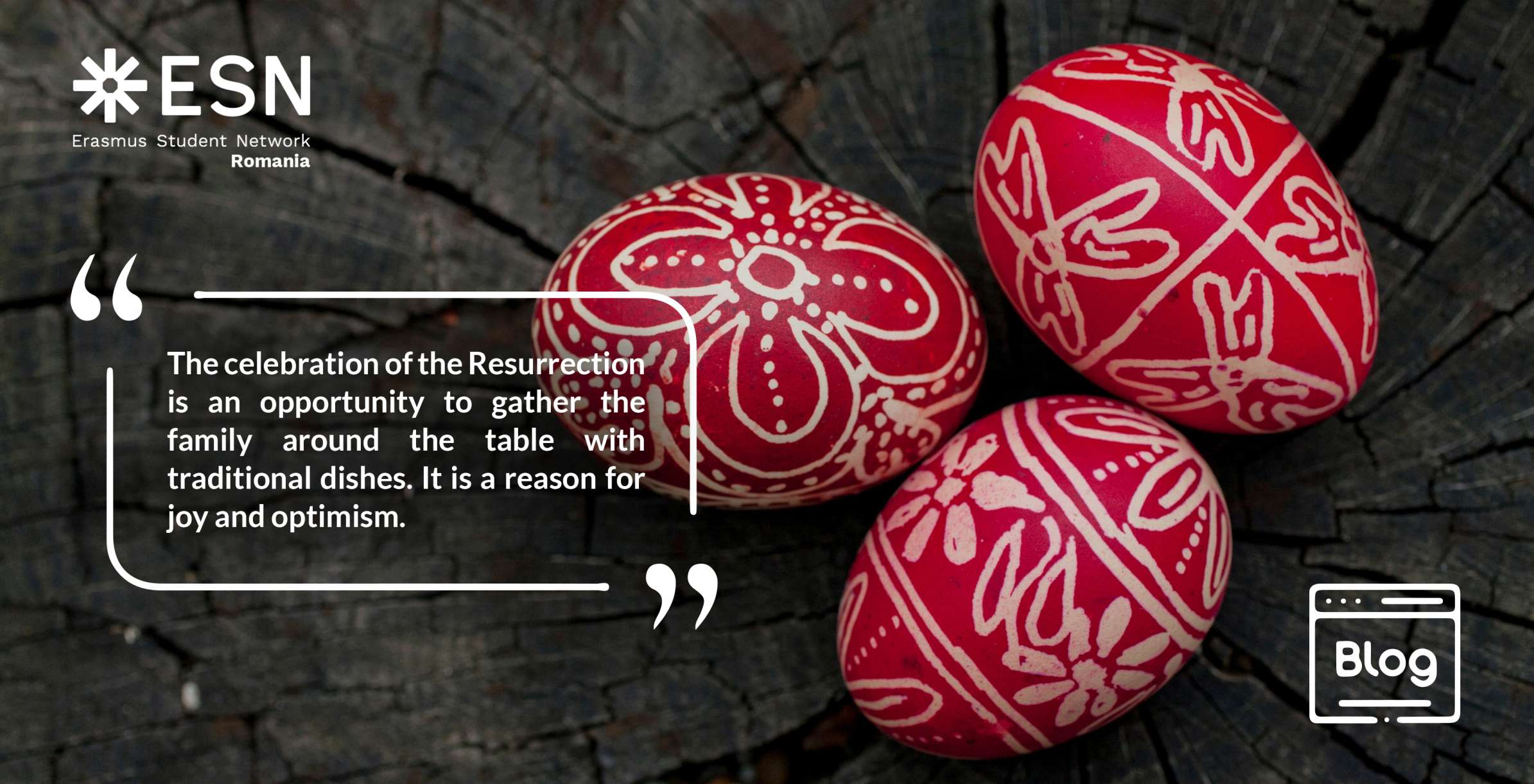
In the end, the celebration of the Resurrection is an opportunity to gather the family around the table with traditional dishes, it is a reason for joy and optimism. Easter brings all the family members together, wherever they are, because this holiday holds a great importance and has a deep meaning.

 
places-to-visit-ro
Categories: 
Written by: 
Oriana Iordache

Romanian Bucket List - Places to Visit

Picture this: you’ve already been in your Erasmus country for some time now. You don’t get lost around the city (so much) anymore and you even managed to decode your class schedule! You’ve found your ride or die group of international friends and lately you’ve been trying to plan your first trip. But there’s so much to see and so little time, you don’t even know where to start.


Don’t worry! We’ve got you. Here are some of the places in Romania you should definitely put on your bucket list, so have an eye, pack your bags and let’s go.


Sighișoara

Sighisoara is the only still inhabited medieval fortress in South-Eastern Europe and the birthplace of the famous Vlad the Impaler. Easy to reach from Brașov, Târgu-Mureș and Cluj-Napoca, during a one-day trip to Sighișoara you can wonder on its lovely colourful streets, admire the view from the Clock Tower and learn about the life of Vlad the Impaler and sighisorean people at MYstical Transylvania… It is also a must to try the traditional soup in bread at the Casa Vlad Dracul restaurant. 


Transfăgărășan & Bâlea Lake

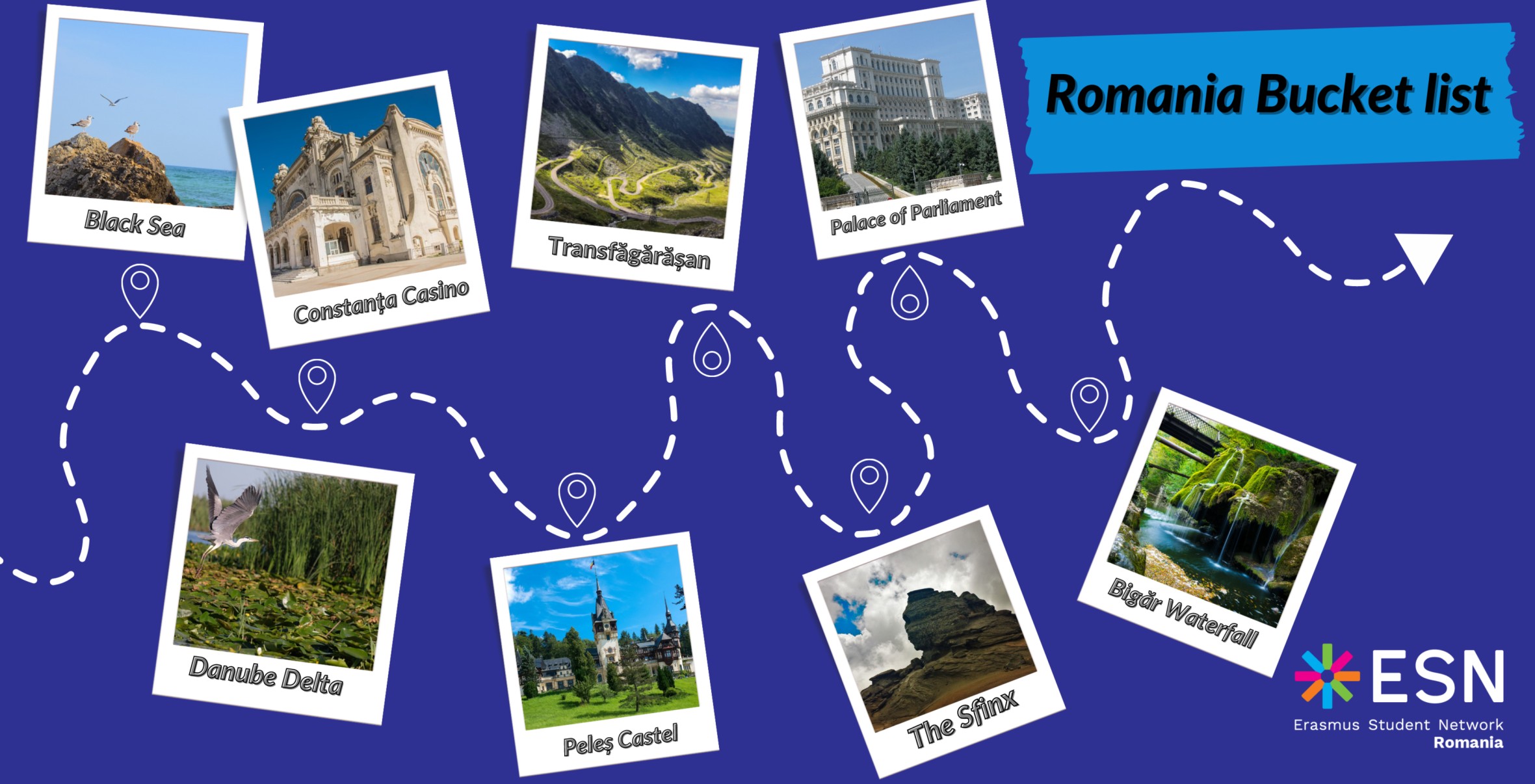
Transfăgărășan and Bâlea Lake should be on the top of your Romanian Bucket List. Transfăgărășan is a breathtaking road through the Făgăraș Mountains starting in Argeș county. It takes you to Bâlea Lake, a spectacular  glacial lake. If you want to spend the weekend there, you can explore the hiking trails to Bâlea Waterfall or Negoiu Peak, but do not forget to wear the right equipment! 


Peleș Castle

Close to Brașov and Bucharest, the Peleș Castle is probably the most beautiful and elegant castle in Romania! Not only eye-catching from the outside, the Peleș Castle has a sophisticated interior design and a wide collection of art pieces, arms and armour and many more!


Babele (the “Old women”) & Sfinxul (the Sphinx)

Up in the Bucegi Mountains, the “Old women” and the Sphinx are geological formations located at over 2000m altitude. Many legends are known around the strange rocks. The “Old women” are a symbol of spring and believed to be The Old Dokia, a mythological figure who turned to stone. The Sphinx is supposed to be the place where the Dacian  king Decebalus killed his son as a tribute to gods and it is thought to be interconnected with the Egyptian Sphinx. Anyhow, they can be reached with the cable car from Bușteni.  Make sure to be there early as there are usually long queues for the cabin. For the adventurous hikers, you can also reach the Omu Peak and the Heroes Cross on Caraiman Peak which are not very far from Babele. 


Turda Salt Mine 

Only half an hour away from Cluj-Napoca, the Turda Saline is an underground wonderland. You can get lost in its numerous chambers, mines and galleries, hop on a boat tour on the underground lake or go to the amusement park. You are in for a unique experience! 


Maramureș

Maramures is a picturesque area in the north of Romania. Here you should definitely check out Mocănița and the Mery Cemetery. Mocănița is a steam train that takes you on a 5-hour ride through Maramureș mountains to enjoy the stunning views. The Mery Cemetery is known for its colourful tombstones. Other popular tourist attractions in this area are the Bârsana Monastery, Horses` Waterfall and the Memorial of the Victims of Communism and of the Resistance. 


ASTRA Museum

Very close to Sibiu, the ASTRA museum is an outdoor museum of over 96ha where you can wander for hours.  In the park you find traditional houses bringing together styles from all over Romania. 


Corvin's Castle

One hour away from Alba-Iulia, The Corvin Castle is one of the largest gothic-style castles in Europe. One legend says that Vlad the Impaler spent some time imprisoned in this castle. The castle has two large areas, The Knight’s Hall and The Diet Hall and the Torture Chambers in the underground prison. 


Oradea

In the west of Romania lies Oradea, a city with delightful architecture inspired by the Art Nouveau style. During a one-day trip you should totally visit the Darvas House, the Roman Catholic Cathedral and the Oradea fortress and take a picture in the exquisite historical center. 


Palace of Culture

The impressive Palace of Culture in the city of Iași hosts museums related to arts, history, science and Moldavian ethnography and other temporary exhibitions. Don’t miss the chance to climb up in The Clock Tower where you can book a guided tour only twice a day at 10:40 and 11:40. 


Moldavian Monasteries

The north of Moldavia region of Romania is well-known for preserving numerous monasteries. The most popular one is Voroneț monastery also called the Sistine Chapel of the East. It was built by Ștefan the Great and it is unique for the special shade of blue it is painted in. Other monasteries are Văratec, Putna, Moldovița and Humor. 


Categories: 
Written by: 
Tudor Țoțovînă

Folklore-inspired Romanian customs in modern days


New to Romania? Curious about its history or customs?

Well, we got you covered. At least partially, since we’re not going to discuss the abundance of history this amazing country has, as it would take far too long to do so.


However, we are here to give you some insight into Romania's customs with folk clothing coming up - stay tuned for this. 

Most of our customs began in rural areas, inspired by folk stories or Christian traditions. The amazing thing is that most of our customs are, to this day, alive and adapted to modern society.


Easter Tradition - Ouă încondeiate (decorated eggs)


Let’s start off with something most of you are familiar with: Easter. Each country has their own Easter traditions, or ways of celebrating it.

In certain areas of Romania eggs are painted in a marvelous way - via a process “încondeiere”. Simply put, amazing designs are masterfully embroidered onto eggs as it can be seen below.
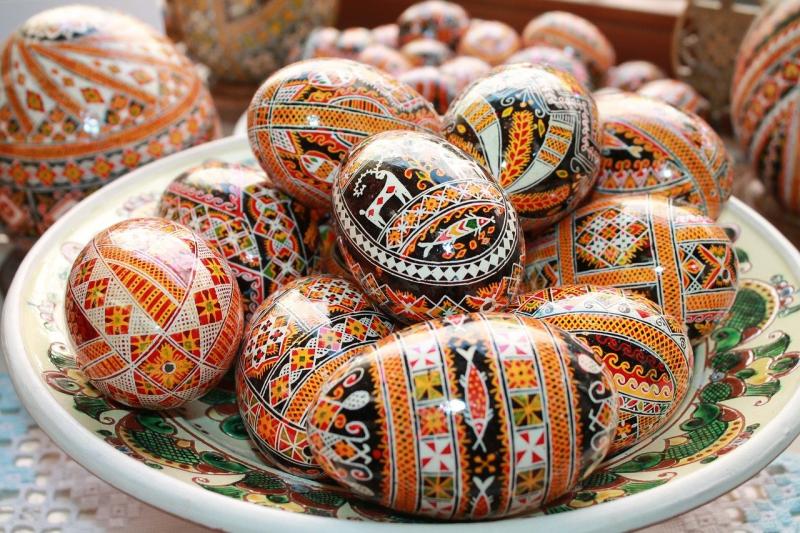
 

Ouă încondeiate - decorated eggs


“Încondeierea” can be done on natural or wooden eggs, with the design depending on regions and its traditions.

Bucovina, a region in the North of Romania, is the ‘go-to’ place for embroidered eggs. True art is created on this occasion, with plenty of motifs - wheat ear, the sun, leaves and so on. 


Christmas and New Year Traditions - Christmas Caroling 


Moving onto Christmas, we find people of all ages from rural areas gathering together, to go carolling. They do so on Christmas Eve and usually go on for two, three days - depending on the area. Breath-taking carols are sung, folklore masks are worn and sometimes even disguises of bears and other forest animals are being improvised.
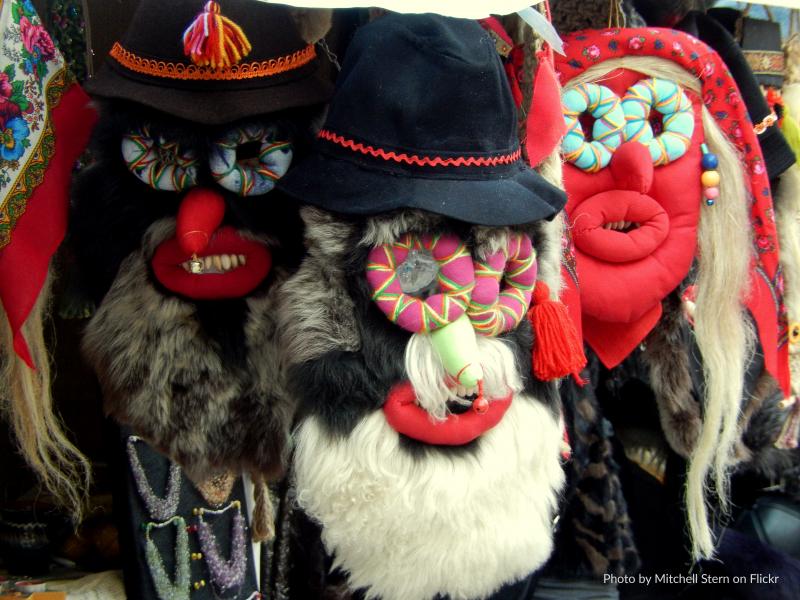
 

Christmas Market masks, Bucharest Romania


Urban areas adapted carolling as well, but something is lacking.

Perhaps you could witness both during your Erasmus and let us know what is that lacking element.
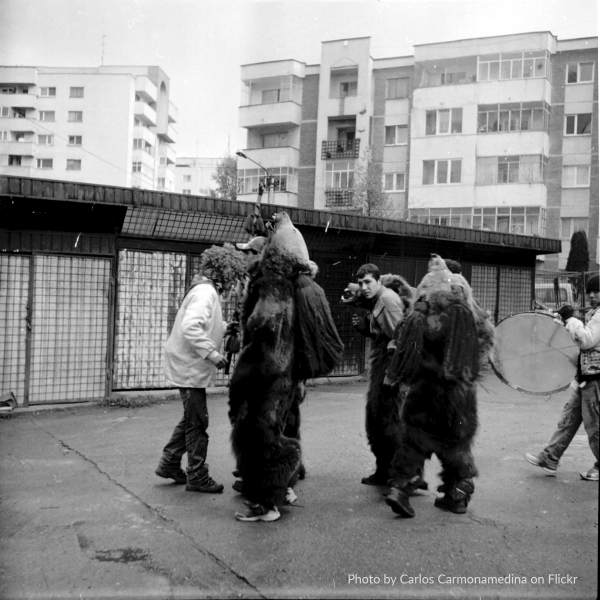
 

    Christmas carolers in bear skins, Cluj-Napoca Romania


We’re not done with carolling yet - we like to sing a lot, and take plenty of our ways of doing it from Christian traditions.

On Christmas Day, young people improvise a star, dress up as the three mages and go around the village/city to let people know that Christ was born.

After a break of a few days, comes New Year’s Eve and the day after. On this occasion, Romanians go carolling with “Plugușorul” - an agricultural carol which is being sung alongside bells and whips.

“Aho, aho, copii și frați” - the start of “Plugușorul” will have all Romanians instinctively thinking about its continuation. Really, try it and see if we’re right.
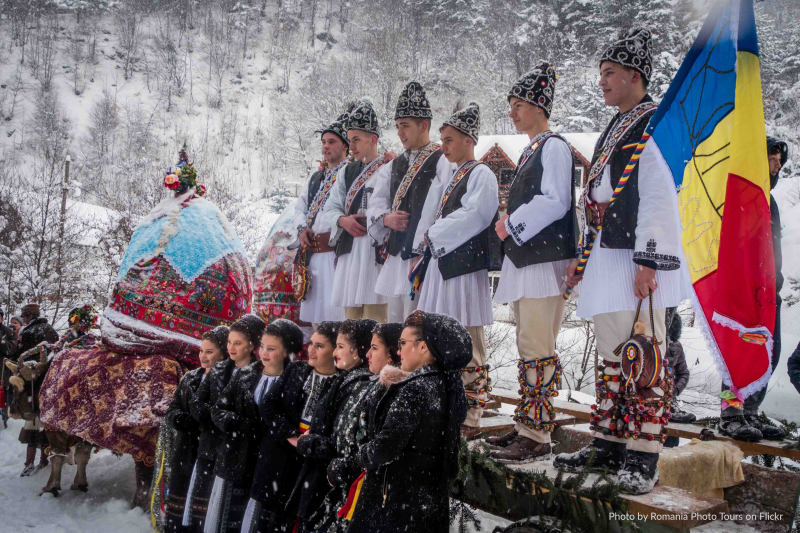

Christmas traditions in Maramures, Romania


Spring Tradition - Mărțișor


From eggs to carols, our customs are diverse and unique. While talking about unique traditions, we absolutely have to mention: “Mărțișorul”.

Foretelling the coming of Spring, Mărțișorul is an old custom which gained more popularity than even embroidered eggs. 


Celebrated on the 1st of March, Mărțișorul is a handmade amulet or symbol tied together with two strings. The two strings are of different colours: white - symbolizing divinity and purity; and red - symbolizing love, friendship. Some could also associate the two colours of the strings with the two main seasons: winter and summer.

It is usually a gift that men give to women, with women wearing their favorite Mărțișor for the whole month of March. While in Romania, you should search for Mărțișor workshops and create your own!
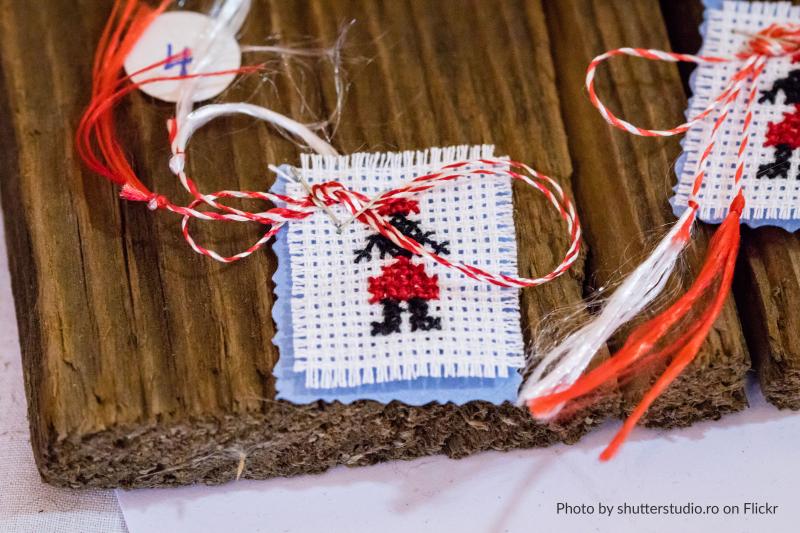
 

Mărțișor with traditional Romanian motif


Wedding Tradition - Stealing the bride


We talked a lot about customs revolving around Holidays or special days. But what is that one special day that most of us go through?

That’s right, wedding time. In Romania, there are a lot, and I mean a lot of wedding-related customs. They vary, based on region, but one has managed to overcome the barriers regions might have. 

“Furatul miresei”, translation - stealing the bride-to-be. It’s a custom in which the bride is stolen, usually by the best man, or close friends of the groom, and a ransom is being asked from the groom or from the godfather/godmother.

Ransoms may vary and are oftentimes creative - love poems for the bride, dancing on amusing songs and the list can go on - it all depends on how the negotiating goes.


Aren’t our customs fascinating? And this is just the tip of the iceberg.

As mentioned before, there are many more customs in this amazing country and all of them vary a lot, based on region.


We challenge you to explore Romania and its customs as much as you can during your Erasmus.

Are you up for it?

 
How does music influence us?
Categories: 
Written by: 
Alexandra Cojocaru

How does music influence us?

Wherever we are, at any given point in time, we are surrounded by music. While some people may view music as a combination of vocal or instrumental sounds, music is in fact much more. Think about breathing or a clock ticking, even a leaking pipe – no classic instruments, but with a little creativity music may appear. One can simply not imagine life without music. In the words of Luis Armstrong, „music is life itself”. So how does it all impact us?

Music as a form of therapy

Music can be used in daily life for relaxation, to gain energy when feeling drained, for catharsis when dealing with emotional stress, and in other ways as well. Research has shown that music has a profound effect on your body and psyche. How you may wonder? First of all, a strong beat stimulates brainwaves to resonate in sync with the beat, therefore a faster beat can lead to more alert thinking, while a slower tempo can put you in a state of calmness. The same rule applies to your breathing. Fast tempo, equals more frequent and unregular air intakes, while a slower tempo allows you to have a paced breathing.

Music as a mood influencer

In films, soundtracks or pieces of music directly relate to how viewers will feel. Ever wonder why a certain ad stuck with you? What about that ad that you so often see and slowly start to despise? Think about it, did it have a catchy tune, have you ever found yourself humming the melody? Research has shown marketers use music in advertisements for this exact reason. To make the ads memorable, create a certain emotion and make their product more desirable. In the end, you should feel that buying that product will make you feel as shown in the ad.


Music and culture

Music is a great way through which one can discover a new culture, as well as create great bonds between people. Travelling, listening to local music, is a great place to start your journey of uncovering the beauty of a new culture, the history of a nation, and almost like a time capsule, music can be captured for eternity. Music can also be used to learn a language. For example, think about the time you were a kid and started learning the alphabet.

Meeting new people is great, but this may not come so easily to everyone. But bring someone with a guitar (any other instrument should work as well), or a speaker at a gathering and everyone seems to relax and start chatting. Maybe your favourite tune starts playing, you start grooving and when you look around the room, a couple of others seem to enjoy the song just as much as you. Chances are, you might have more in common with them than initially thought and you just found your conversation starter.

There is no denying that music is all around us, whether we realise it or not. It can be very beneficial, be it for making new bonds with people, lifting your spirits or creating and helping you deal with certain emotions. Music will not let you down.

“Life is one grand sweet song so start the music.” – Ronald Reagan

Halloween in Transylvania - group picture at Rasnov
Categories: 
Written by: 
Maria Fotache

Halloween in Transylvania 2019 - Discover Romania with exchange students

The mysterious and intriguing Road to Dracula led the 2019 Erasmus+ students to the discovery of the beauty and friendliness of Brasov. Halloween in Transylvania represents the most wanted event organized by Erasmus Student Network Romania, because of its unexpected ways of unravelling the secrets of the region. The wilderness of Brasov’s nature gave the Erasmus+ students the chance to take a breath of fresh air, while the architecture of the city and of the castles stand impressive in front of their eyes, making them feel like guests of honour.

Participants at Peles CastleHaving fun while discovering new ways to express yourself represents a major part in our mission of integrating people from all over the world.
Peleș welcomed the Erasmus+ students with its characteristic royalty and sense of beauty. They enjoyed the opportunity of observing a royal lifestyle and showed a real interest in Romanian culture, architecture and history. On the second day of Halloween in Transylvania, the Erasmus+ students followed Dracula’s path right to his home, Bran Castle. The historical heritage is as grandiose as the construction, the mystery being at the core of its popularity. After the visit to Bran, the students learned about Rasnov Citadel, another main attraction in Brasov. The view was astonishing and the climb felt easier because we were all together, making memories for life. Volunteers or students, we were all brought closer by the same feeling of being part of this great family which is Erasmus Student Network.

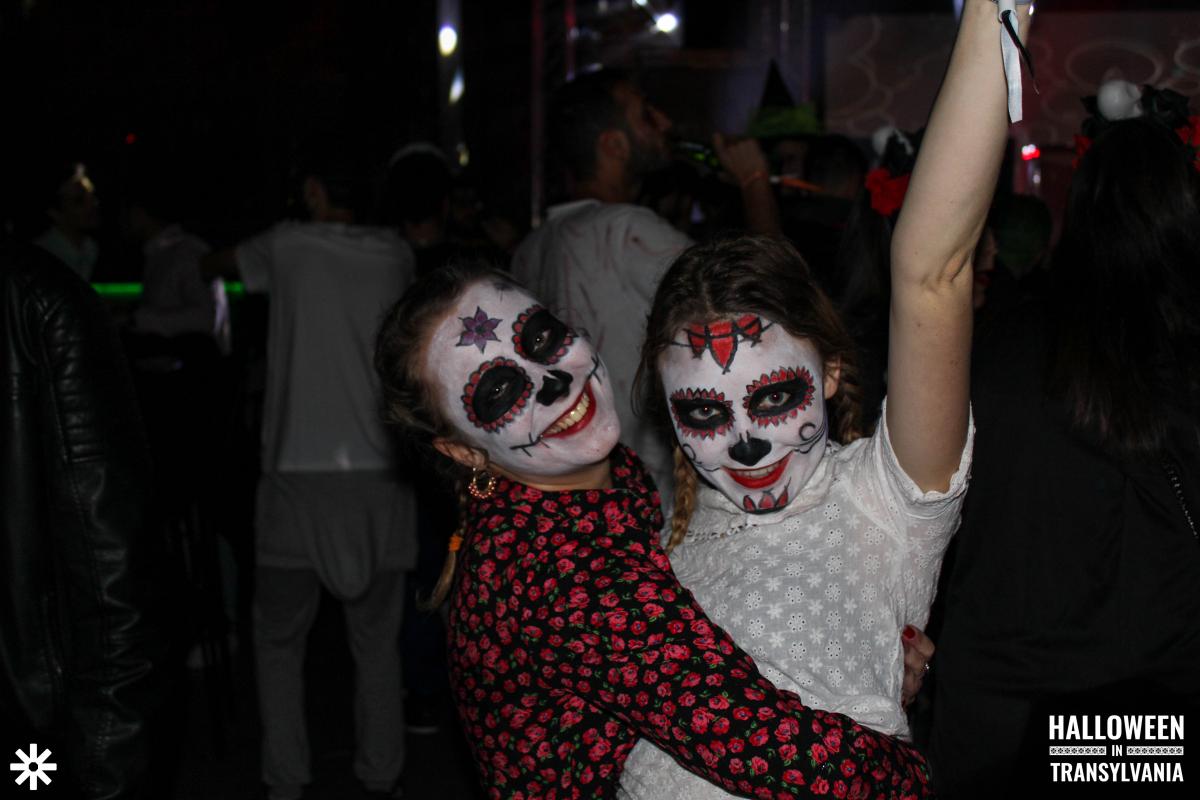
Participants at Halloween Party


On the other hand, the wildest creatures lit up the darkest night of the year, at the first party of this edition of Halloween in Transylvania. Good girls gone bad, vampires, zombies along with various characters scared every bit of sleep and danced the night away, at Halloween Party. Seems like a costume and some loud music are the main ingredients in this exciting mixture of imagination. Halloween in Transylvania took a mysterious turn on the second night of the event, at Masquerade Ball. To follow the old concept, every student put on fancy dresses and elegant suits and created a nonconventional party. Every hidden face uncovered the true beauty and the joy that lie within every student.

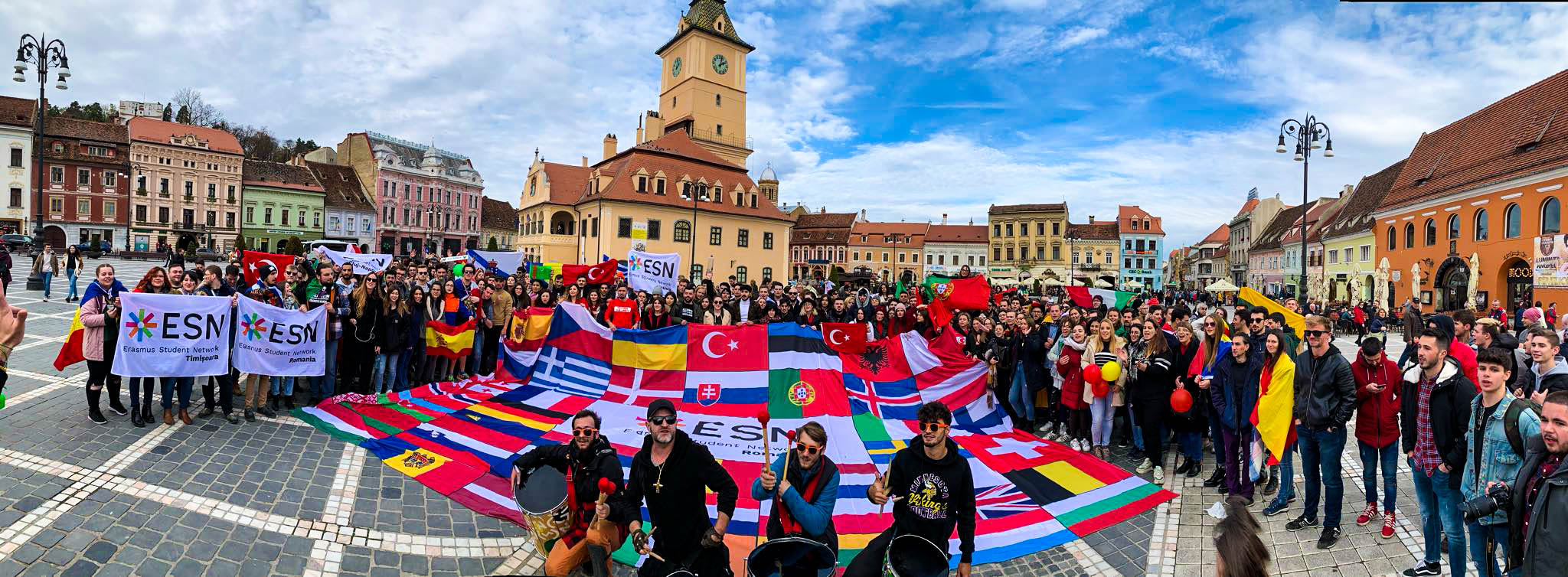
Participants at Flag Parade

The third day of the trip meant intense emotions, big smiles and a lot of color. The sensational Balasa percussion band guided the students with their amazing rhythm. The Erasmus+ students made Flag Parade the most exciting event and their contagious energy took over Brasov's streets. Drums, flags and hearts, were all synchronized to create one of the most iconic moments of Halloween in Transylvania. Seven hundred voices and souls were brought together by the same feeling of unity. Even if we don't share the same colours when it comes to flags, we, for sure, share the love for this amazing family.

“This event truly made me feel like I am part of the Erasmus Generation” - participant, HiT 2019

During the last day of the event, the great treasures of Brasov were hunted down by our excited Erasmus+ students. The City Contest was meant to bring together teams of enthusiastic students and make them see Brasov through a different perspective, one that involves a lot of determination and strategy. Volunteers waited patiently for each team to reach every point on the map and complete every task. It was even more fulfilling seeing the smiles on their faces and the eagerness to win in their eyes. It was ‘the best way to arrange a city tour’, as one student said.

Erasmus Student Network tries to offer students from all around the world better opportunities to learn and become aware of the cultural and social impact of people and places. Halloween in Transylvania reinforced the idea that when we are together we are stronger and happier.